Author: Shelli Martineau

  • Organization Hacks: Bullet Journaling and The Notecard System (Plus, My Hybrid)

    It’s a new year and people are once again zazzed about organization, getting in shape, and being fitter/happier/more productive (Radiohead anyone?). I’m a big fan of optimism and efficiency, and have a wicked Organization Fetish so I LOVE this time of year for the inspiring content alone.

    We’re developing an attention span problem…

    The age of tech has given us a baffling and sometimes debilitating amount of information at our finger tips. Yet as our access to information increases, it seems as if the benefits of all that information are lacking. In fact…

    • Tech, apps, and gadgets are awesome, but all those screens and notifications can lead to distraction instead of productivity.
    • We read tons of blogs, websites, white papers, books, videos,  etc but it’s becoming harder and harder to retain, digest, and truly think about what we consume.
    • Many people learn by doing &/or think by jotting things down, but technology has made many forms of note-taking obsolete or redundant.
    Organization Hacks-Bullet Journaling +Solutions exist…

    There are systems and thought leaders out there paving the way to making us more thoughtful in 2015. In fact, I’ve come across two analog solutions for our digital productivity woes in the past two months alone:

    Bullet Journaling
    IMG_5068
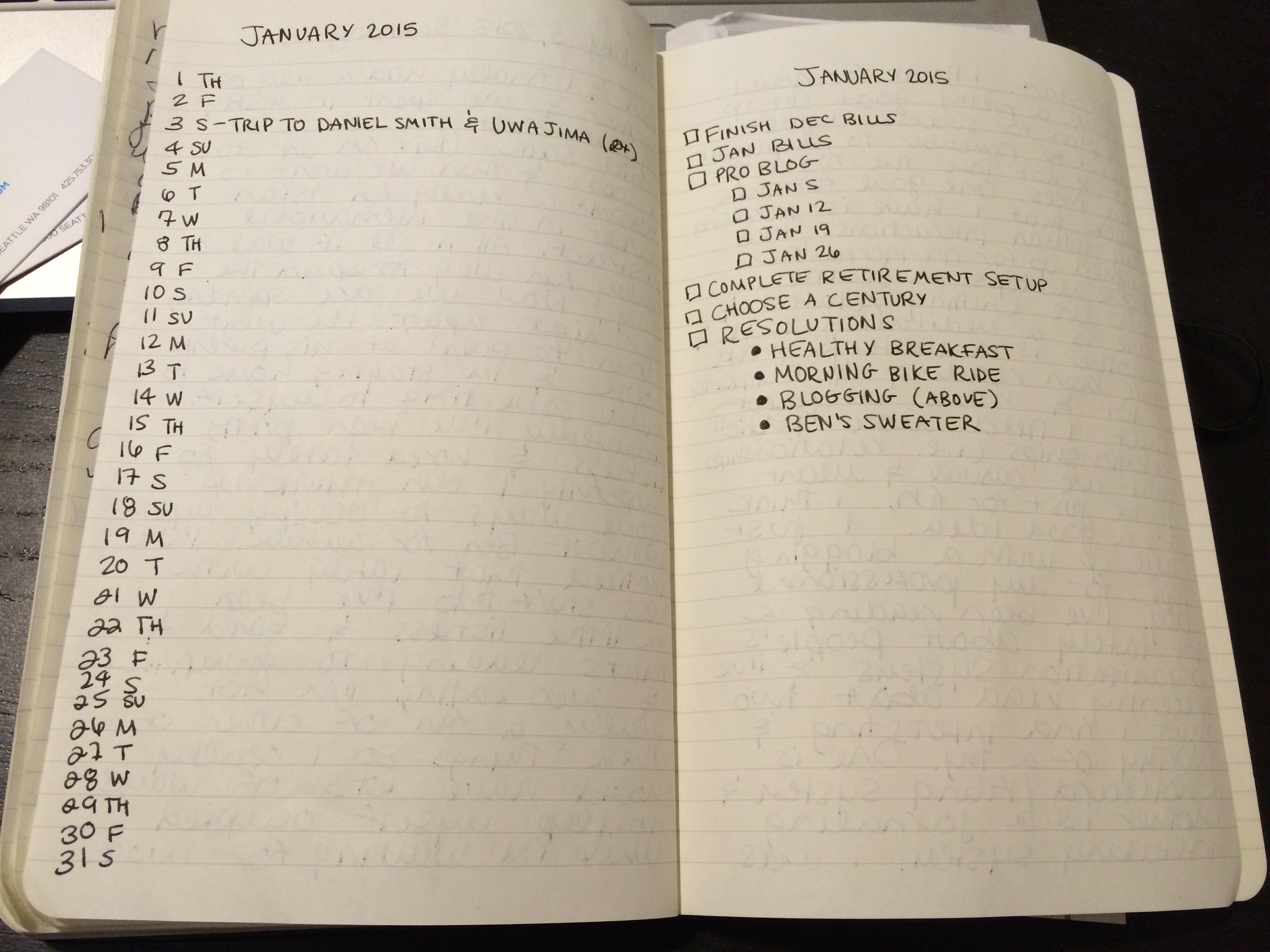
    Bullet Journal: Monthly Calendar & Tasks

    Check out this video by Ryder Carroll. Bullet journalling is a quick, analog way to track tasks, events, notes, thoughts and ideas in one  journal. No apps or software required. 

    The ritual in a nutshell: At the beginning of each month, create a monthly calendar and task list using the prescribed bulleting system. Use the monthly calendar and tasks to guide daily tracking on subsequent dates and pages. Create categories to track big ideas. Make an index page at the beginning of your notebook to track and find entries.

    The Notecard System aka “The System” 
    IMG_5070
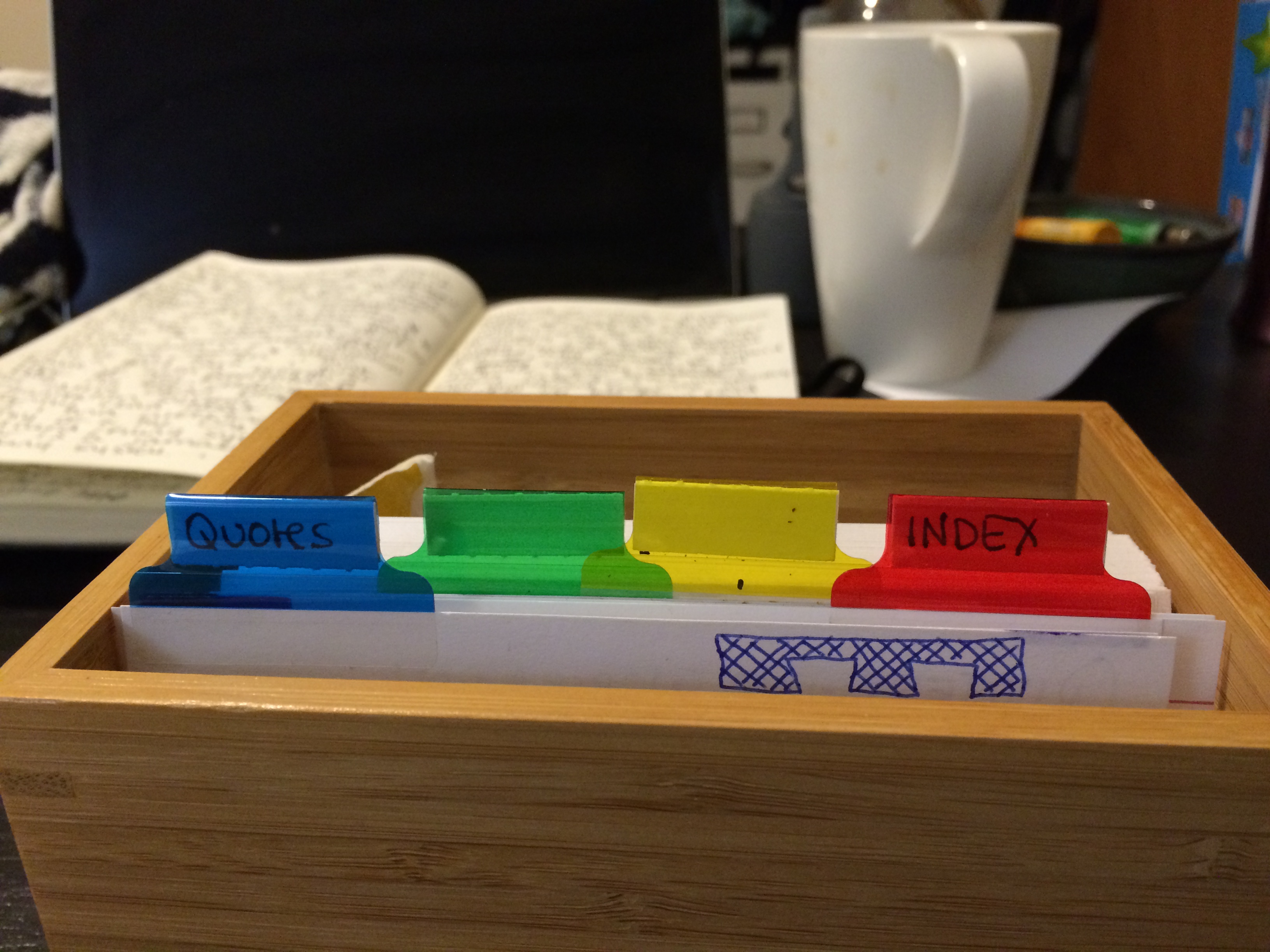
    The Notecard “System”

    First brought to my attention by @RyanHoliday who learned it from Robert Greene. It’s another analog way to track tasks, notes, thoughts and ideas. The slowness of this system is actually a benefit in that it forces the user to stop, think, and distill information. 

    The ritual in a nutshell: Write thoughts and ideas on a 4×6 notecard and identify them with a theme or category at the top of the card. Use a filing system to keep track and turn category cards into content generators for blog posts and book chapters.

    …I’d like to add a thought:

    Both of the above systems are exciting for Type A nerds like myself. I like the quickness & organization of bullet journaling & the deep ritual/slowness of the notecard system.

    What if we combined the two?

    The problem for me is that I write too much to be a devout user of a single system. My journals fill up way too quickly for Bullet Journaling (I write at least 3 pages a day, and the whole index and page numbering thing would just end up pissing me off). Plus, I don’t think I need to store, track and record everything I write. Sometimes I write just to think out ideas which can be condensed into smaller, usable bits of information. Discardable shopping lists don’t need to be kept along with ideas for my next blog post and/or evergreen inspirational quotes.

    I’ve come up with my own hybrid version of both systems that incorporates my favorite parts.

    2_1_IMG_5067.png
    Bullet Journaling: Signifiers

    My favorite parts of Bullet Journaling:

    • Monthly Calendar
    • Daily Calendar
    • Bullets/Signifiers
    • Migration (moving unfinished tasks forward which forces prioritization and reflection).

    My favorite parts of The Notecard System:

    • Long Term Categories (Filing system)
    • Deep habit/ritual
    • Distilling information from what I’ve read into useable, bite-sized, organized cards

    A New Ritual?

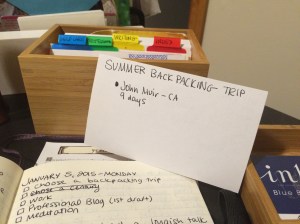
    In 2015 I’d like to start thinking of my journal as a place to store short term information. Things like a monthly/daily task lists fit perfectly there. The Notecard System makes more sense as a long term idea storage and organization system. A place to keep & track big ideas to be used for subsequent blog posts, books, or whatever.
    IMG_5074
    My Funky Little Hybrid: Daily Bullets + Notecards

    Here’s what I’m thinking:

    • Daily Journaling: Use my journal to flesh out a daily calendar and to write my morning pages (at least three handwritten pages).
    • Monthly Journaling: Keep two pages in my journal as a monthly calendar and migrate important, unfinished tasks forward. Fill it in as I complete stuff.
    • Daily Notecards: Keep a notecard in the book I’m reading to jot down ideas and quotes for later research and reflection. Make a habit of saving quotes and sticking them in proper categories.

    Do you use a note-taking and/or journaling system? What do you use and how is your system working out? Share it — I’d love to see how you’re working.

  • My Actual Goodreads Goal: Books To Read In 2015

    I read 22 books last year.

    Well, my actual number is a little higher (there were some I didn’t record. I’m a meager self-quantifier), but my Goodreads list is pretty damn close. Apparently my “goal” for 2014 was 36 books (which I didn’t meet and only vaguely remember setting), and after a little sleuthing, I determined that I blew 2013 out of the water (9 books according to Goodreads).

    So, all in all, 2014 was an excellent year for literature in my world.

    Screen Shot 2014-12-30 at 11.00.05 AMAll that said, I won’t be setting a specific number goal for 2015 (well….. I might… but…) for me, reading isn’t about the numbers. Don’t get me wrong, I’m a voracious reader and love to brag about what a smarty I am, but I tend to read slowly. I’m not looking to finish with the most books under my belt. I read to find inspiration, to draw insights, and to savor big ideas. Sometimes I even take notes. I try to read mindfully and that’s my real Goodreads goal for 2015.

    So, in an attempt to be mindful about my 2015, I’ve been reading 2014 and 2015 book lists (yeah, reading about reading) and I’ve come up with a list of books that I think will make my 2015 inspirational, insightful, and pretty damn awesome. I’d feel a little remiss if I didn’t share the list with you guys, so here it is — enjoy!

    Books to Read in 2015

    Nonfiction

    I’m actually most excited to get started on some fun, inspiring, and insightful nonfiction. These are my 5 picks for 2015.

    • My First Summer in the Sierra (John Muir) – It’s an old one, but I’ve got cabin fever and am itching to do some more long hikes and bike rides. Muir will have to tide me over until the Spring! From the cover, “Picturesque descriptions and sketches by one of America’s most important and influential naturalists describes the author’s 1869 stay in California’s Yosemite River Valley and the Sierra Mountains. Muir’s engaging journal describes majestic vistas, flora and fauna, as well as the region’s other breathtaking natural wonders. 21 black-and-white illustrations.”
    • The Innovators: How a Group of Hackers, Geniuses, and Geeks Created the Digital Revolution (Walter Isaacson) – This one is on countless lists so I’ve decided to give it a try. From the cover: “The Innovators is Walter Isaacson’s revealing story of the people who created the computer and the Internet. It is destined to be the standard history of the digital revolution and an indispensable guide to how innovation really happens.”
    • Alan Turing: The Enigma (Andrew Hodges)A movie based on Turing’s life was released in 2014. While I haven’t seen the film, I am curious about Turning and his work, so I added this one to my list. From the cover, “It is only a slight exaggeration to say that the British mathematician Alan Turing (1912-1954) saved the Allies from the Nazis, invented the computer and artificial intelligence, and anticipated gay liberation by decades–all before his suicide at age forty-one.”

    Fiction

    I turn to fiction when I’m having a bad day. There is nothing like hiding one’s nose in a novel to cure the blues. This time last year I was obsessed with The Hunger Games Trilogy (loved it!) this year I’m looking forward to reading these guys:

    • All the Light We Cannot See: A Novel (Anthony Doerr)From the cover, “Marie-Laure lives with her father in Paris near the Museum of Natural History, where he works as the master of its thousands of locks. When she is six, Marie-Laure goes blind and her father builds a perfect miniature of their neighborhood so she can memorize it by touch and navigate her way home. When she is twelve, the Nazis occupy Paris and father and daughter flee to the walled citadel of Saint-Malo, where Marie-Laure’s reclusive great-uncle lives in a tall house by the sea. With them they carry what might be the museum’s most valuable and dangerous jewel.”
    • We Were Liars (E. Lockhart) – The buzz on this one is excellent. From the cover, “A beautiful and distinguished family.
      A private island.
      A brilliant, damaged girl; a passionate, political boy.
      A group of four friends—the Liars—whose friendship turns destructive.
      A revolution. An accident. A secret.
      Lies upon lies.
      True love.
      The truth.”
    • Big Little Lies (Liane Moriarty) – Yet another with great word of mouth. From the cover, “Big Little Lies is a brilliant take on ex-husbands and second wives, mothers and daughters, schoolyard scandal, and the dangerous little lies we tell ourselves just to survive.”
    • Winds of Winter (George R.R. Martin) – WoW made my list despite it having not actually having a set date for publication. It’s here because I’m EAGERLY anticipating it’s release and rumor has that might happen in 2015. If so, I will promptly drop everything and pick it up.
    Well, that’s my list! I’m curious — what are you planning to read next year? Do you have any recommendations for me? Tweet or leave a comment. Happy Reading!
  • Buy Experiences, Not Things

    This Week’s Inspiration:

    Last week, in casual conversation, I heard no less than three separate parents lament that their kids have TOO MUCH STUFF.

    “WAY. TOO. MUCH…!”

    Their words echoed in my brain as I slowly went over my dwindling gift-giving options for their kids. I was reminded of the common-sense notion that we should buy experiences, not things (which was recently confirmed in newly published research). I was inspired to get the kids things they could DO versus things they could have.

    As the holidays draw near, I hope you can do the same and simplify your life during the holidays. It feels great to plan and discover ways you can anticipate, gather stories, & and collect memories instead of spending money on stuff.

    Last Week’s Link Love:
    • If you’re looking to enhance and grow your email marketing, but are tired of the same old pop-up suggestion lists, check out this post from Zapier with 10 Email Marketing tricks you’ve probably never tried.
    • Brands can tell rich and engaging stories. This Patagonia video is worth watching as a fascinating example of branding AND storytelling — it’s actually entertaining and very inspiring (especially for outdoorsy types)!
    • Upworthy has the goods when it comes to viral social media success and averages an incredible 60k+ shares per article (roughly 5x Buzzfeed’s rate). Heidi Cohen (don’t you just love her posts?) shares how you can recreate that success.
    • This post by Samuel King is packed full of information & how-to guides on Content Curation – it’s very comprehensive and an excellent primer to help get you started.
    • Is the future of Social Media Marketing pay to play? The signs point to YES. 

    News You Might Have Missed (Because You Were Too Busy Doing Real Work):

    Lastly, don’t let the holidays get you down. Make the season what you want it to be! If Joel, the Lump of Coal, can make it happy, so can you. 

    – Shelli

    P.S.  Social Brew is a  regular newsletter full of links you can check out while having your morning coffee. I share links about social media, content marketing, writing, and other interesting, relevant, newsworthy, helpful or just plain cool stuff.

    Subscribe now and never miss a post! 

  • The Right Words Are Simple

    Welcome to Social Brew a regular, curated post full of links you can check out while having your morning coffee. Social Brew is mainly links about social media, content marketing, writing, and other stuff that is interesting, relevant, newsworthy, helpful or just plain cool.

    Subscribe now and never miss a future issue.

    This Week’s Inspiration: 

    “One day I will find the right words, and they will be simple.” – Jack Kerouac

    Links I Loved Last Week:
    News You Might Have Missed (because you were too busy doing real work):

    Lastly, please enjoy these Louis C.K. motivational posters (they may just get you through the week). 😉

    – Shelli

  • The Perfect Headline Is Six Words Long

    Welcome to Social Brew a somewhat regular, curated post full of links you can check out while having your morning coffee. I’ll share links about social media, content marketing, writing, and other posts that are interesting, relevant, newsworthy, helpful or just plain cool.

    Subscribe now and never miss a future issue.

    This Week’s Inspiration: 

    Say ‘yes’ to what matters and let the rest go (inspired by this post from Zen Habits).

     Links I Loved:
    • I also happen to be perfect, so all my headlines are naturally amazing (sarcasm!!). But, for the rest of you mere mortals, Neil Patel has researched and developed a formula for the perfect headline (hint: It’s just six words long).
    News You Might Have Missed Because You Were Too Busy Doing Real Work:
    • New studies find that 80% of Twitter’s active users are on mobile, and 77% are outside of the U.S.
    • Shut up & take my money!! This alternative tea kettle is eco-friendly AND it boosts your hipster points by like a bazillian.

    Also, I participated in NaNoWriMo last month and actually finished! Here are 7 surprising things I learned while participating in the madness.

    NaN

    Lastly, have you tried Google’s new inbox? What do you think? Is it just me or is it sort of hard to figure out?

    – Shelli

    P.S. Don’t forget to Subscribe to Social Brew and never miss a future issue. Have a happy week!

  • Social Brew: The Beginning

    Welcome to Social Brew a somewhat regular, curated post full of links you can check out while having your morning coffee. I’ll share links about social media, content marketing, writing, and other posts that are interesting, relevant, newsworthy, helpful or just plain cool.

    Subscribe now and never miss a future issue.

    This Week’s Inspiration: 

    “Sign your work and own the results” – Seth Godin

     Links I Loved Last Week:
    • “To attain knowledge, add things every day. To attain wisdom, subtract things every day.” – Lao Tzu. I love this reminder from Matthew May on the power of subtraction and the “Art of Adding by Taking Away.”
    • Where my ladies at?! Recently, while networking and interviewing for jobs around Seattle, it dawned on me that most of my meetings are with men. I’ve worked with many whip-smart and very talented female leaders, but we need to continue to support women in the tech industry. Some even go as far as to say that Our Future Depends On Women In Technology.
    • This was my most clicked link last week. If you’ve found a product market fit and are ready to accelerate customer acquisition, you might want to check out this incredibly helpful guide to creating buyer personas by Jun Loayza.
    News You Might Have Missed Because You Were Too Busy Doing Real Work:
    • I find this ridiculously cool, so I’m calling it news. It’s a real world button you can use to control your favorite apps. Analog is back, baby! You heard it here first.
    • Soon when your boss catches you on Facebook it might not be such a bad thing. To further their clearly evil plot to make us share everything we do, Facebook is making ‘Facebook at Work’ a thing in 2015.

    Lastly, please tell me you’re listening to Serial too (I’m lookin’ at you, Karen). Tweet me what you think!

    Also, don’t forget to Subscribe to Social Brew and never miss a future issue. Have a happy (shortened) week!

    – Shelli

  • Why your social media strategy should be built like a tiny house

    In America we’ve always loved big and flashy. This is especially true when it comes to where (and how) we choose to live. In the wake of the housing crisis, however, many people are now shifting their focus from large “McMansions” to minimalism and Tiny Houses. This shift in desirable housing size speaks to, in my opinion, a larger need for our collective society:

    We may like big and flashy, but we crave quality and heartfelt.

    In my opinion, building your social media strategy should be a lot like constructing your very own tiny house.

    What are “Tiny Houses” Exactly? 510px-Tiny_house,_Portland

    The Tiny Life explains, “[Tiny House] is a social movement where people are downsizing the space that they live in. The typical American home is around 2600 square feet, while the typical small or tiny house is around 100-400 square feet. Tiny Houses come in all shapes, sizes and forms but they focus on smaller spaces and simplified living.“

    “But what does this have to do with social media strategy?” you ask. Well,

    • “Tiny housers,” as they are collectively known, deeply understand that pre-planning, care, and attention to detail are crucial. They take their time planning, preparing, and they measure twice before cutting (as the saying goes). They become experts at learning on the go and stay nimble in case unexpected problems arise. Your social strategy should be much the same. It is crucial and necessary to have a plan of action, steps, desired outcomes, and measurements before launching your social strategy. Your plan should also be nimble and flexible allowing for “a ha” moments of insight.
    • Tiny housers focus on quality and maximizing space. When faced with the proposition of living in less that 400 square feet of space, tiny housers must figure out who they are and what they really need to be successful.  So should you focus on priorities and ask: What is important? What do I need? With what do I want to surround myself? What can I let go?
    • We’ve all seen half-assed, lazy, ugly, tacky or downright boring and ineffective social content. The reasons for this are varied: many community managers just follow the beaten path, some don’t feel passionate about the topic they’re put in charge of, others are bored or have had their autonomy taken away, etc. etc. The list goes on!. As with a tiny home, your social strategy should be made with love, by people who take ownership of the task at hand; those who cares deeply about the end result. Social strategy should never be farmed out to uncaring, impatient interns just because they’re the biggest Instagram fans on your team.
    • Using sustainable, recycled, and renewable products helps cut cost and time for tiny homes. Your social strategy should absolutely take advantage of the resources you already have: repurpose content to get lots of traction, capitalize on work you’ve already done, ask employees for insights and watch what the competition is doing so you can discover tactics that suit your needs. This focus on sustainable and “recyclable” actions will help keep time and budget down.
    • As I mentioned earlier, social media is about people, community, and building relationships. Because of their chosen environment, those who live in small houses must interact with the people they live with. They can’t easily hide in another room when things get rough so they focus on relationships, improving communication, and working together for the collective happiness. So too should your social strategy focus on the people you hope to live, work, and sell to.
    • Lastly, though it’s not necessarily an overtly stated goal, many tiny housers understand and embrace the “WOW factor.”  there is nothing more deeply satisfying than putting hard work into something and proudly announcing, “I made this.” At the end of the day, you should look at your social strategy, tactics, and channels with that same feeling of a job well done.

    I could go on and on but I sense you probably now understand the metaphor. My favorite thing about Tiny House building is that there is no perfect or gold standard for building one’s home. In this, our digital age of fast, cheap and easy, I highly recommend embracing this same grass roots, heartfelt, focus on quality.


    P.S. Tiny house builders, ask for (and receive) help. If you have any social media marketing questions or comments feel free to share them. I love to pitch in where I can. 😉

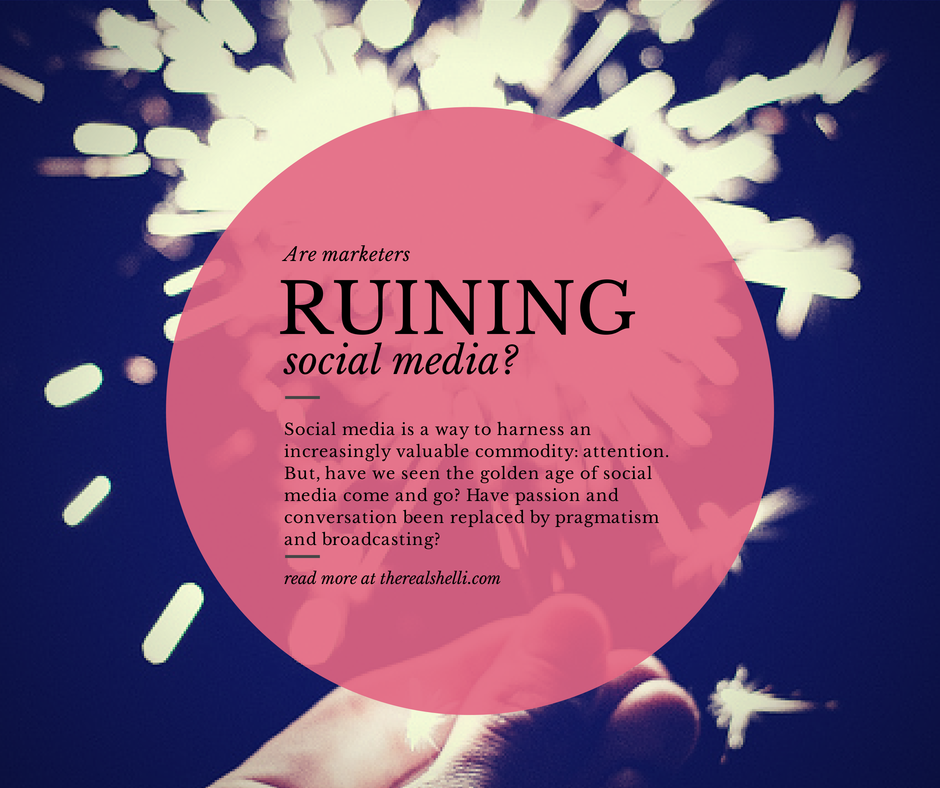
  • Are Marketers Ruining Social Media?

    At the risk of sounding like a grumpy old person shouting at the kids on her lawn and complaining about the long-gone good old days, one question has been at the back of my mind for a while now:

    Are marketers ruining social media? Untitled design (2)

    When I first started working in social media 5 amazing years ago I was, admittedly, wildly optimistic. I loved my job because it was the chance to talk to people, to be creative, to listen, and to be a part of something different. Since then, I’ve held on to a few steadfast beliefs that have shaped my work over the years. They are (in part):

    • Social media is for talking with people who share a passion. It’s my job to facilitate a two way conversation between brand and fans.
    • If something is worth writing, it’s worth writing well.
    • Respect pays in dividends and people are not dollar signs.
    • An effective storyteller is also an excellent listener.
    • Social media gives us the opportunity to surprise, delight, inspire, help, gossip, serve, and tell a story.

    I’ve been fighting to hold on to these core values as social media has grown and evolved into something that people actively try to ween themselves off of.  Aside from a few radicals who are still holding out, social media is now something different:

    • Passion and conversation have been replaced by pragmatism and broadcasting.
    • Writing is cheap, generic and boring.
    • Respect and service can be automated.
    • Listening = Metrics
    • Stories are sales pitches.

    Admittedly, I saw this coming. We all did, right?  Social media is a way to harness an increasingly valuable commodity: attention. That said, I still believe the best social media marketers are the ones who stick to the core tenets that our social business was built on. There are still some who still understand the traditional, self-serving ‘all push’ method of marketing is dead. They deeply care about the end-user and don’t see people as merely prospects.

    So, I’d like to ask you….. no, beg you…. to remember the good old days of social before you hit ‘publish’ next time. If it helps, this is my litmus test for all posts, editorial calendars, and content plans I write:

    • If this came through my personal newsfeed would I like, comment on, or share this?
    • Is this content unique, entertaining, educational, informative, or inspirational?
    • Is this timely and relevant to fans of the page?
    • Would I call this a low quality image, post, or meme?
    • Would I complain about seeing this content in my News Feed?

    I’m curious. Do you agree? Are marketers ruining social media?

  • 20 Easy to Use, Free, and Reliable Tools for Social Media Management

    One of the questions I get asked most is, “What tools do you use for social media?” and I often have to say something like, “it depends.” There are lots of social media tools out there each with it’s own purpose, strengths, and limitations.

    I like to tell people I’m tool agnostic. It’s a term that was originally coined by Monique Elwell (at least that’s who I originally heard use it) and I love it because it accurately describes how I view Social Media tools. I’m not loyal or faithful to any one specific tool, per se. I choose tools that help me get the job done; those that are easy to use, free (or reasonably priced), and reliable.

    Wrench

    Here are a few of my favorites broken down by what I use them for:

    Collaboration/Project Management

    • Google Docs/Drive – Google has an entire suite of free apps that make content creation and collaboration simple no matter where in the world you are working from. Changes are real-time and everything is stored in the cloud so you can access it from any device and share your work with anyone.

    • Trello – Trello is an awesomely engineered, free, and easy to use project management site. Use it to keep track of checklists, due dates, team members, upload attachments and more.

    Finding & Curating Content

    • Reddit – Reddit is called “the front page of the internet” and it’s my new addiction. I’m checking my favorite subreddits from my smartphone whenever I have a few free minutes to myself. To explain it simply: content is submitted and voted up or down by users. The good stuff always floats to the top and the conversations are as informative as they are weird, silly and awesome. The best news always hits reddit first.

    • Scoop.it – Admittedly, my awesome colleagues Karen and Nik are bigger scoopers than I, but it’s still a place I go to find information on my favorite topics.

    • Feedly – Long live RSS! Sadly, Google Reader is no more. For years I’ve used Google Reader to track my favorite blogs. It saved me the pain/hassle of visiting 100+ websites daily by bringing their content to me automagically. With Google Reader saying goodbye, I’ve made the switch to Feedly which essentially does the same thing. Click here for an awesome list of social media marketing resources to fill up your Feedly.

    Finding, Editing and Creating Images

    I wrote an entire post about this. But, my top 5 faves are:

    • Instagram – No surprises here, right?

    • Google+ – Did you know you can edit images using Google+? Yep! Google provides some great filters, plus you can add text.

    • Stock Xchng – One of the best free photo sites out there.

    • Flickr  – Per Flickr, “Many Flickr users have chosen to offer their work under a Creative Commons license”, and you can browse or search through content by clicking Advanced Search > Only search within Creative Commons-licensed content.

    • Quozio – Have an excellent quote burning a hole in your pocket? Quozio will make it a pretty image – fast!

    Daily Management

    • Hootsuite – An all-in-one dashboard to manage multiple social networks including: Twitter, Facebook, LinkedIn, Google+ Pages, Foursquare, WordPress, and more.

    • Buffer – Add interesting blog posts, pictures, and even video to your Buffer Queue and it automatically shares them with your audience throughout the day.

    • Pages Manager (Android and iOS) – Keep tabs on your Facebook Pages even when you’re not near the computer.

    Listening

    I wrote an entire post about this too, but my top 5 faves are:

    Measurement

    If you’re not sure what or how to measure, start here.

    • Hootsuite – Build custom reports using over 40 social analytics “modules” or select from pre-made reporting templates.

    • Facebook Insights – Every page has Facebook Insights which provide metrics around content. You can export your metrics and use them to analyze user growth and demographics, consumption of content and more.

    • Sprout Social – Sprout Social helps you to create beautiful reports that get both a high or low level look at performance.

    • Bit.ly – A quick and easy way to track links (Count clicks, see how platforms are performing).

    Automation

    IFTTT – A service that triggers actions based on a simple formula: If THIS then THAT. For example, you can automate a post to your Facebook Page every time you share a picture on Instagram with a certain hashtag. I always warn people to use automation with extreme caution and to avoid it whenever possible.

    Which tools do you use for social media management? Did I miss any good ones?

  • Social Media Measurement: What’s Your Focus?

    One of the most commonly asked questions I hear about social media is, “How do you measure it?”

    I have a love/hate relationship with this question, because if I answer “incorrectly” I could potentially alienate myself from someone I’m trying to help:

    • If I say that measurement is important, but should only be used as a tool – not a focus – I might sound as if I’m trying to avoid responsibility or accountability.
    • If I list off metrics and some tools that can be used to capture them, I feel I’m not doing my full duty or giving a false impression about the value of social media.

    While I won’t label one side as right or wrong, I will say measurement should always be based on your goals. After all, that which you focus on becomes what you’re good at.

    295417_1283

    So, when I get asked the “How do you measure it?” question I usually follow up with, “What’s your focus? What are you hoping to achieve?”

    What’s your focus?

    When the goal is to capture attention, generate awareness, and/or build a reputation, I will usually suggest measuring:

    • Reach
    • # of Friends/Fans/Followers
    • # of Retweets, Reblogs, Shares
    • Growth Rate
    • # of Views
    • # of Blog Visitors
    • # of Subscribers

    If the goal is to engage and influence, I’ll likely suggest:

    • Likes
    • Comments
    • Shares
    • Clicked links
    • Mentions
    • Retweets
    • #hashtag users

    But that’s not the whole story….

    If the goal is to delight fans there are few tools or metrics I can offer up. True, there are many free and paid listening tools available and there are tools out there that claim to be able to measure sentiment (i.e. delight). However, currently no sentiment measuring tool is entirely reliable or accurate (in my opinion) and, even if if you have the most fine-tuned listening station possible, you are still only really getting a piece of the picture.

    That’s what I love about social….

    One thing I love about social media is if you’re doing it right – you’ll know. If you’re watching, you can see delight spread across your social channels.

    Take it from an expert….

    Seth Godin wrote something really clever about success measurement that I love:

    “I’d have you obsess about things that are a lot more difficult to measure. Things like the level of joy or relief or gratitude your best customers feel. How much risk your team is willing to take with new product launches. How many people recommended you to a friend today…

    What are you tracking? If you track concepts, your concepts are going to get better. If you track open rates or clickthrough, then your subject lines are going to get better. Up to you.”

    – Seth Godin

    Seth couldn’t be more correct – especially when it comes to social media. Ultimately, social is about people. It’s about delight, surprise and meaningful interactions that inspire conversation and interaction.

    What are the goals for your social presence(s)? What are you measuring?